

What is a DC SPD?
2025-10-20
In an age where direct-current (DC) systems such as photovoltaic arrays, energy storage units and EV charging installations are proliferating, the role of a DC surge protective device (DC SPD) has become indispensable. A DC SPD is a protection solution designed for DC power networks that safeguards equipment from transient overvoltages—spikes caused by lightning strikes, switching operations or other disturbances.
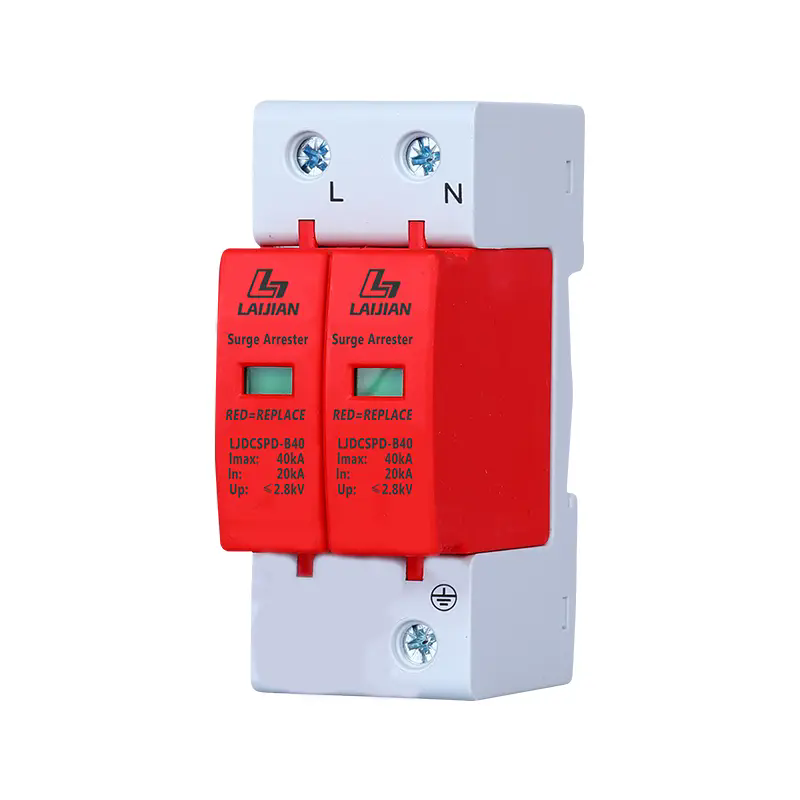
At its core, this piece conveys:
-
A clear definition of the technology and its key parameters.
-
Why DC-specific protection differs from AC, including typical application scenarios and risk mitigation.
-
How DC SPDs operate, how to select the correct product, installation best-practices and future directions.
Key Technical Parameters at a Glance
| Parameter (Symbol) | Typical Explanation | Typical Value Range* |
|---|---|---|
| Maximum Continuous Operating Voltage (Uₙ or Uc) | The highest DC voltage the SPD can continuously withstand | e.g., up to 1 000 V DC for many PV/EV systems |
| Nominal Discharge Current (In) | The surge current rating the SPD is designed to handle in standard surge event | Tens of kA (e.g., ≥10 kA) |
| Maximum Discharge Current (Imax) | The peak surge current capability (short-term extreme) | e.g., ≥40 kA in some models |
| Voltage Protection Level (Up) | The clamping or let-through voltage at which the device acts | Preferably ≤1.5× rated equipment voltage |
| Response Time | How quickly the device reacts once a surge occurs | Typically ≤25 ns for DC systems |
What: Defining DC SPD and Its Core Role
What is a DC SPD?
A DC surge protective device (DC SPD) is a specialized protection component for direct-current electrical systems. Unlike AC protection devices, a DC SPD is configured for unidirectional current and continuous voltage conditions typical in DC networks.
Its primary function is to detect a surge event (e.g., induced by lightning or switching), divert or clamp the excessive energy swiftly (via MOVs, GDTs or hybrid components), and thereby protect downstream equipment from damage.
What are typical application scenarios?
Some of the most common scenarios for DC SPD deployment include:
-
Photovoltaic (PV) system DC-side protection (strings to inverter)
-
Communication base-station DC power systems (battery/bus protection)
-
Electric-vehicle (EV) charging infrastructure and energy-storage DC systems
-
Industrial DC drive or motor systems requiring robust surge mitigation.
What distinguishes DC SPD from AC SPD?
A key point is that you cannot simply use an AC surge-protector in a DC system without risk. AC and DC SPDs differ in design because DC circuits lack the natural zero‐cross of AC and may have different insulation, grounding and polarity requirements.
For example:
-
DC systems require polarity-sensitive components, whereas AC systems often do not.
-
DC systems may face continuous currents, so components must manage sustained stress rather than only transient rapid pulses.
-
AC SPDs might fail or create fire risk if used incorrectly in DC systems.
The Importance of DC SPD in Modern Systems
Why does surge protection matter in DC systems?
In DC systems, surges and voltage spikes can originate from lightning strikes (direct or induced), system switching (such as disconnects, inverters, or contactors), or internal faults. These overvoltages can degrade or destroy sensitive electronics, cause insulation breakdown, lead to system failure or fire hazard.
Installing a DC SPD extends equipment life, supports system reliability, reduces downtime and maintenance cost, and enhances safety.
Why is DC protection especially critical in certain applications?
-
Solar PV installations: DC side of PV arrays is more vulnerable to surges due to long strings and exposed wiring; damage to panels or inverters can be costly.
-
EV charging and energy storage: These systems use high-voltage DC, strong currents and tight equipment tolerances; a surge could impact battery management, inverter control or charging modules.
-
Telecom/Industrial DC systems: For mission-critical equipment (e.g., base stations, control systems), even short disruption due to surge damage is unacceptable.
Why selecting the right DC SPD matters
Selection must align with system voltage, surge risk level, installation environment and response requirements. A mismatched SPD may not provide protection, may degrade prematurely or introduce safety hazards.
Incorrect installation or undervaluing of parameters can lead to equipment failure or fire risk; for example using an AC SPD in DC systems is strongly discouraged.
Mechanisms, Selection, Installation and Future Trends
How does a DC SPD work?
A simplified sequence:
-
Under normal operation, the SPD remains in a high-resistance (non-conducting) state.
-
When the DC system voltage rises above the SPD’s threshold (clamping voltage Up), the internal MOV or GDT component rapidly switches into low-resistance state.
-
Surge current is diverted safely to ground or to a discharge path, limiting the over-voltage seen by protected equipment.
-
After the event, the SPD returns to standby mode, ready for next event (if designed for multiple events).
How to select a proper DC SPD?
Key considerations include:
-
Ensure the SPD’s Uc matches or exceeds the system’s nominal DC voltage.
-
Choose an In and Imax that correspond to the level of surge risk in the installation (e.g., open rural PV vs indoor telecom cabinet).
-
Confirm the Up is less than the withstand voltage of the equipment you’re protecting.
-
Confirm compliance with relevant standards (e.g., IEC 61643-11 for SPDs) and certifications.
-
Review environmental factors: altitude, temperature, enclosure, mounting method.
-
Consider installation method: proximity to equipment, grounding path length, wiring inductance (short wiring is better).
How to install and maintain a DC SPD?
Installation best practices:
-
Install as close as possible to the equipment to be protected to minimise surge path inductance.
-
Use appropriate cable sizes, secure terminations and low-impedance grounding.
-
Ensure correct polarity and connection as required by the device.
-
Provide labeled status indication or remote monitoring if available (some SPDs include remote contacts).
Maintenance tips:
-
Periodic inspection (e.g., every 6-12 months) of visual status indicators and grounding integrity.
-
Replace SPDs if indicator shows fault, after a major surge event, or if age approaches manufacturer’s recommended lifetime (often 5-10 years).
-
Maintain logs of inspections and replacements.
Common Questions & Answers
Q: Can I use an AC surge protector in a DC system?
A: No, using an AC SPD in a DC system is generally unsafe and ineffective. The design of AC SPDs assumes alternating-current behavior (zero-crossing, periodic current reversal) which does not apply in DC. Employing an AC device on DC may fail to protect equipment and could pose fire risk.
Q: What is the difference between a 2-pole and a 3-pole DC SPD?
A: In DC systems (especially PV or energy storage), a 2-pole SPD typically protects the positive and negative conductors. A 3-pole SPD adds protection of the grounding or reference conductor as well (positive, negative, ground). The choice depends on system configuration and whether the ground or neutral connection is present/required.
How is the technology evolving and what are future trends?
-
As DC-based systems proliferate (higher-voltage battery systems, HVDC links, large-scale solar + storage), demand for SPDs rated for higher voltages (1 500 V DC and above) is increasing.
-
Integration of remote monitoring, status indication (visual + remote contacts) and smart fault-logging features is becoming more common.
-
Materials and topology advances to handle higher surge currents, faster response times (<25 ns) and lower let-through voltages.
-
Adoption of stricter international standards and certification for DC systems to match the maturity of AC SPD products.
-
Growth of hybrid SPDs combining MOV, GDT and TVS technologies to provide layered protection for complex DC systems.
What’s Next for DC SPD, How to Move Forward and Why It Matters for Your System
What should stakeholders do next?
Operators of DC power systems should audit existing surge protection arrangements and assess whether current SPD solutions are rated and installed properly. As system voltages rise and DC penetration increases, legacy protections may no longer suffice. A protection upgrade may be prudent.
Design engineers should factor surge protection into system architecture from the outset, specifying correct SPD types, placement, grounding, monitoring and maintenance procedures.
Purchasing decisions should focus on documented specifications, manufacturer reputations, certification, life-cycle support and availability of status indication or remote monitoring.
Why this investment is strategic
Deploying a correctly specified and installed DC SPD means improved system reliability and uptime, fewer equipment failures, reduced maintenance and replacement costs, as well as enhanced safety. With many DC systems being high-value (solar farms, battery energy-storage systems, EV infrastructure), protection against surges is a relatively small investment compared to potential recovery or downtime costs.
How to implement a robust plan
-
Audit and assessment: Determine system voltage, surge risk, equipment sensitivity, existing protections.
-
Specification: Choose SPD with correct Uc, In, Imax, Up, compatibility with system environment and mounting.
-
Installation: Ensure proper location, grounding, wiring length, secure terminations, status monitoring.
-
Maintenance & review: Establish inspection schedule, record logs, replace as needed, update protection as system evolves.
Future orientation: Why staying ahead matters
As DC power infrastructure continues to expand — from distributed rooftop PV to grid-scale battery storage to EV ultra-fast charging hubs — the threat of surges and transient events becomes more frequent and more consequential. A system that lacks adequate surge protection risks unplanned downtime, equipment damage and increased maintenance cost. As regulatory scrutiny and standards evolve, compliance will become more important.
In summary: adopting advanced DC SPD solutions today is not just a protective measure—it is a strategic enabler for reliability, safety and cost-efficiency in the growing DC ecosystem.
In the rapidly evolving environment of direct-current power systems, surge protection via a robust DC SPD is not optional—it is essential. Advanced products delivering rapid response, high current capacity, low let-through voltage and remote monitoring capabilities provide the backbone of a resilient DC infrastructure. As one of the brands delivering these high-performance solutions, Laijian stands ready to support system designers, installers and operators in deploying the right surge protection for their needs. To learn more about tailored DC SPD solutions, contact us today and safeguard your DC systems for the future.